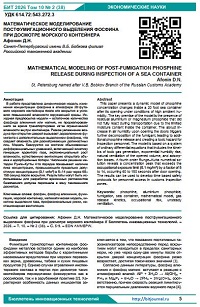
Mathematical Modeling of Post-Fumigation Phosphine Release during Inspection of a Sea Container
Abstract
This paper presents a dynamic model of phosphine concentration changes inside a 20 foot sea container after its opening under conditions of high ambient humidity. The key premise of the model is the presence of residual aluminium or magnesium phosphide that did not fully react during transportation due to the limited moisture content inside the container. The abrupt increase in air humidity upon opening the doors triggers further decomposition of the fumigant, leading to additional phosphine release and creating a toxic hazard for inspection personnel. The model is based on a system of ordinary differential equations that includes the kinetics of toxic gas generation, exponential humidity rise, natural ventilation of the opened volume, and adsorption losses. A fourth order Runge–Kutta numerical solution reveals a concentration peak that exceeds the occupational exposure limit (0.1 mg/m³) by a factor of 5 to 14, occurring 60 to 150 seconds after door opening. The results can be used to develop time based safety protocols for personnel access in customs inspection zones.References
Code of practice phosphine. Doc 162/18. – European industrial gases association AISBL, 2018. – 11 p.
Namala S., Gonam V., Girish A. (2022). Temporal and spatial distribution of phosphene from aluminum phosphide in grain storage bins // J. Exp. Zool. India. – 2021. – Vol. 24, No. 2. – P. 1241-1244.
Головань Т.В., Тонконог В.В., Арестова Ю.А. Проблемы безопасности должностных лиц таможенных органов при проведении досмотра контейнеров, обработанных фумигантами // Проблемы социальной гигиены, здравоохранения и истории медицины. 2022. Т. 30, № 4. С. 592-599. DOI 10.32687/0869-866X-2022-30-4-592-599.
Афонин Д.Н. Экология труда сотрудников таможенных служб, проводящих досмотр фумигированных товаров // Социальные новации и социальные науки. 2025. № 1(18). С. 141-152. DOI 10.31249/snsn/2025.01.09.
Афонина А.Д. Меры обеспечения безопасности должностных лиц таможенных органов при таможенном контроле фумигированных грузов и процессуальные аспекты выявления таможенных преступлений // Актуальные проблемы науки и практики. 2025. № 4(42). С. 14-17.
Афонин Д.Н., Афонин П.Н. Информационно-техническое обеспечение при таможенном контроле веществ, предназначенных для сохранности товаров. Москва: Общество с ограниченной ответственностью "Русайнс", 2024. 160 с. ISBN 978-5-466-03509-4.
Постановление Главного государственного санитарного врача РФ от 28.01.2021 № 2 (ред. от 24.12.2025) «Об утверждении санитарных правил и норм СанПиН 1.2.3685-21 «Гигиенические нормативы и требования к обеспечению безопасности и (или) безвредности для человека факторов среды обитания» (Зарегистрировано в Минюсте России 29.01.2021 № 62296) (с изм. и доп., вступ. в силу с 01.03.2026). [Электронный ресурс] // СПС «КонсультантПлюс». URL: https://www.consultant.ru/cons/cgi/online.cgi?req=doc&base=LAW&n=517341.
Афонин Д.Н. Обеспечение безопасности должностных лиц таможенных органов при досмотре морских контейнеров // Ученые записки Санкт-Петербургского имени В.Б. Бобкова филиала Российской таможенной академии. 2018. № 1(65). С. 7-11.
Phosphine: Incident management. – UK Health Security Agency, 2024. – 18 p.
Copyright (c) 2026 Afonin D.N.

This work is licensed under a Creative Commons Attribution-NonCommercial-NoDerivatives 4.0 International License.